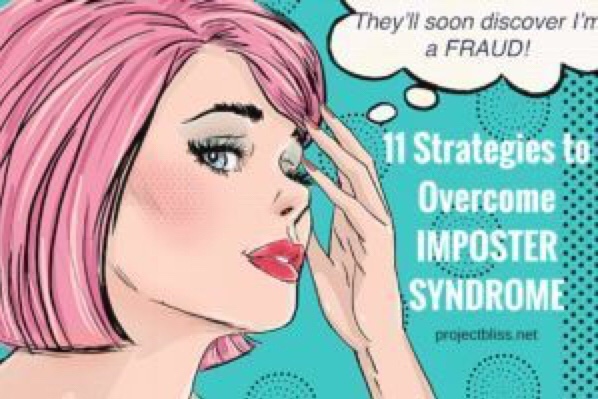
I read something from someone somewhere here the other day about ‘Imposter Syndrome’. “It’s a terrible thing,” this person said, “but we know that we all have it.” And I thought about that statement for a while and found that I had to disagree with it. Because we don’t know that we have it. We just hope that we do.
Because the primary symptom of ‘Imposter Syndrome’ is not knowing if you have it or not, but suspecting pretty strongly that you don’t.
And then I imagined a conversation with a psychologist on the subject.
This is the conversation ….
She sat across from me looking over the top of her glasses with a fountain pen poised theatrically above her notebook. The first thing I had noticed about her office were the books. I wondered if she had read them all. There seemed to be a disproportionate number of them concerning sex. Sexual abuse. Sexual disfunction. Sexual disorientation. Sexual reassignment. Why were psychologists always so obsessed with sex? Didn’t they care about all the other traps that God had set just to fuck you up?
And then she was trying to deny that she was even a psychologist at all.
“Don’t think of me as a psychologist,” she said, “just think of me as someone to talk to.”
“My grandmother is ‘just someone I can talk to’”, I replied, “but not at $150 an hour.”
“But you can tell me things that you can’t tell her.”
“You obviously don’t know my grandmother.”
But I knew were she was going. She wanted to talk about sex. “I don’t want to talk about sex,” I blurted out.
“That’s fine,” she said. And then we just sat there and looked at each other. She wrote something down in her notebook. What could there possibly be to write down already? I hadn’t even said anything. Except one offhand comment about sex. I felt like I was attending a job interview and somebody else already had the job. She was just waiting for me to slip up and reveal myself as totally unsuitable.
Eventually she broke the silence. “You’re a writer,” she told me.
“Yes. Well … maybe. I don’t know. That’s the whole thing.”
“And you think you suffer from imposter syndrome?”
“Yes. Yes. I’m almost sure of it. I sent you a chapter of my novel. Did you read it?”
“I did,” she replied and jotted down something else about me in her notebook. It was becoming annoying.
“And what did you think?”
She smiled at me in a manner which I interpreted as being condescending and let out a sigh. “I’m not a literary critic, Mr Richmond,” she advised me, “I’m a psychologist.”
“Yes. But you’re a person. A reader. And you’re ‘someone I can talk to’. So tell me,” I begged her, “what did you think?”
“Today, I’m afraid that I can only answer as a psychologist.” She wrote something else down. It was infuriating. I’m not sure that she was even listening. Perhaps she was compiling a grocery list.
“All right then,” I conceded in the end, “Have it your own way. As a psychologist, what did you think of my novel?”
“As a psychologist?” she asked, as if it had been my idea all along. “as a psychologist ….. I don’t think you are suffering from imposter syndrome.”



 Richmond Road