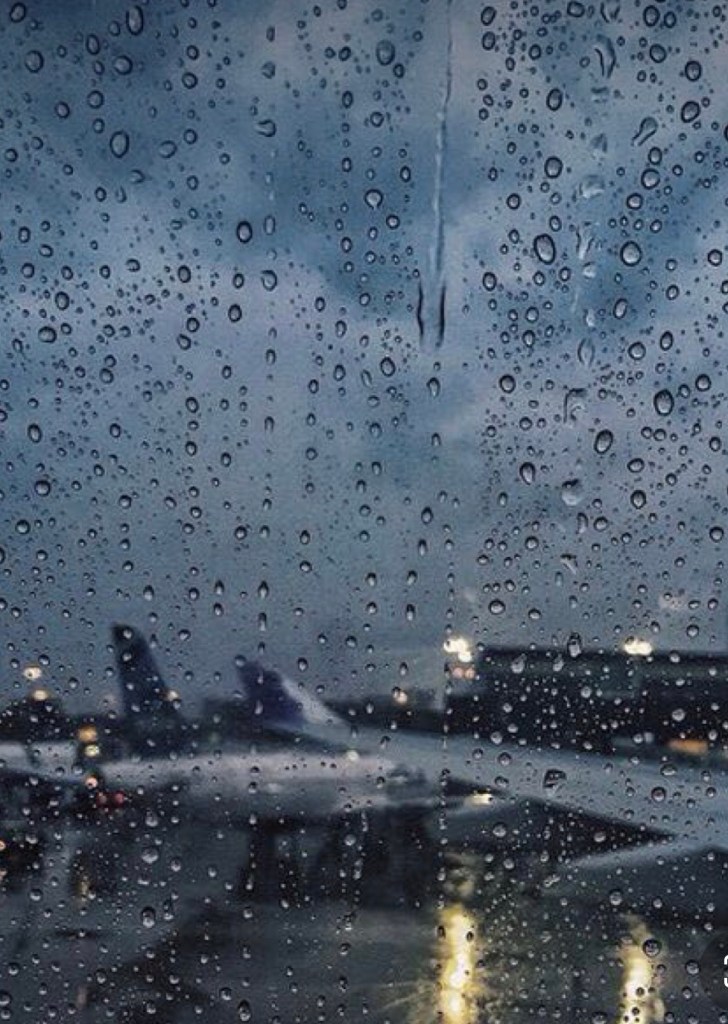
A wet evening at the airport bar.

For one reason or another I have spent a lot of my life hanging around airports. My observation is that, whilst such environments may occasionally bring out the very best in people, the opposite is far more frequently the case.

I was looking through some stuff this morning and came upon this little airport story that I must have produced for a competition some time. I’m not sure if I even bothered submitting it. Certainly I am sure that it did not impress the judges.

And I apologise if you have seen it before ….

*

The rain outside is beating relentlessly against the glass. Gutters overflowing. Waterfalls descending from the roof above until the wind gathers them up and redirects them through every little crack in the windows and under the doors. The staff fighting back with towels and mops. In the distance the aircraft barely visible. Grounded by a force greater than technology. Wings like dead branches quivering in the gale.

Nothing to do but to think and to drink. With a group of stranded transients. Marooned in the airport hotel bar.

On the anniversary of 9/11. Which has added a tension to the air that you can almost taste in the beer. Images of that previous morning of terror flashing across some of the television screens. And on others, scenes of the present wave of mayhem and destruction pouring down on us via the wrath of nature. Such that one might believe that God really does prefer the other side, after all.

The bar is nearing capacity. There’re three couples sharing a table and a few bottles of wine to my left. Straight in front, against the far wall, a group of about twelve Japanese girls occupy a set of horribly coloured lounges. Half the girls are closely examining their phones whilst the other half slump, heads on each other’s shoulders, trying to sleep. At individual tables business men tap away on computers or engage in deliberately loud, allegedly urgent, phone conversations. To my right a table of four Samoans sit in tracksuits, laughing and throwing peanuts at each other. They are part of a football team. They have had too much to drink. So have I.

A fat man stumbles through the door clutching a shopping bag marked clearly with the ‘Toys-R-Us’ logo. Water is dripping from his hair and from his clothes and from his shopping bag. There’s one spot available at the bar beside me and he heads for it immediately, lunging forward before lowering himself into the seat and releasing the long deliberate sigh of a man who is accustomed to failure yet remains surprised with its regularity.

He looks around him and at the bar and at the television screens and he says, “what a mess.”

I’m not sure if the comment is for me. So I ignore it. Then he repeats himself. More forcefully.

“What a fucking mess.”

“Which one?” I ask, as casually as possible. And then he gestures to the screen and to his clothes and to the weather outside and then, somehow, to the whole universe.

“All of them,” he says.

So I pause to let the thought linger a while before giving him the response he wants. “Yeah,” I concede, “I suppose so.” I’m thinking that’s the end of it.

But the dude won’t shut up.

“All of them,” he continues, “the religious scum-bags and paedophiles who are taking over the planet and the climate that is trying to kill us and the bombs that go off everywhere and the earthquakes and the floods and the famines and the guy who is banging my wife.”

This is interesting, I suppose. He has my attention for a moment. I’d like to know how one person’s sense of perspective can be so skewed that they might form a mental link between natural disasters, global warming, international terrorism and what is likely, let’s face it, nothing more than an everyday instance of infidelity.

But turning to really look at this poor sap for the first time I realise that no clues to the nature human existence are to be found within him. He’s just looking for sympathy.

“Bummer,” I observe, after pretending to give it some thought.

And now he’s starting to cry. Pulling a wallet out of his back pocket he withdraws a crumpled photo of a fat little boy. “That’s my son,” he informs me, somewhat unnecessarily, “Jack. He’s eight years old. I get to see him for one weekend a month. And that’s this weekend. And now all the flights are cancelled. I’m stuck.”

“Bummer,” I repeat, with decreasing interest. I can see, though, that he’s becoming agitated. He is getting louder and perhaps a bit aggressive.

“Have you got any idea what that means?” he’s hissing at me, “do you know what it’s like to be separated from the one thing in the world that you truly love?” I give the question some thought. Honestly. But then I have to confess that no, actually, I don’t what that’s like.

And now he’s beginning to yell. The Japanese girls are all awake and staring in our direction with expressions of concern. “Look at this,” he’s openly weeping as he reaches down into the shopping bag, “I’ve got new toys for him and everything,” and from the bag he produces a scale model of a fire engine and what looks like a replica of a Smith & Wesson.

“Gee,” I say, “a plastic gun? Do you really think that’s appropriate for an eight-year-old?”

My well intentioned snippet of parenting advice is not well received. He’s suddenly on his feet and standing over me. I’m beginning to understand why his wife may have looked for alternatives. “What did you say???” he’s shouting, “What did you say??? Are you telling me how to raise my own son?” The tears are still in his eyes, but sorrow is quickly making way for blind rage. His face is the colour of the toy fire engine and he’s waving the toy gun in my face. Things are beginning to get a bit weird.

I catch the first signs of movement to the right out of the corner of my eye. And by the time I look around the four Samoans are already careering towards us like a small herd of buffalo. The Japanese girls are screaming, and someone is yelling out, “He’s got a gun! He’s got a gun! He’s got a gun!”

Then the sound of breaking glass and breaking timber and possibly breaking bones. The startled cuckold letting out a sad grunt as the air is forced from his lungs. Two of his assailants pinning him to the floor as the other two begin laying in with the boot. The bartender appearing suddenly with a baseball bat determined to get a piece of the action. Somebody’s pushed a button and an alarm’s gone off and I think I can see policemen running towards us.

There’s a quarter of a cheeseburger on my plate so I pick it up and finish it. I look to take a last swallow of beer, but my glass has been upended in the excitement.

But looking outside there appears to be, by some miracle, a break in the weather. I can see lights moving out on the tarmac. Gathering my things I step around the bodies and walk towards the door. There’s a burger and four beers on my tab, but nobody seems very interested in that, so I keep my wallet in my pocket.

And suddenly they’re calling my flight.


Things are working out quite well.

*

Little Bits of Bobby

Somebody sent me a poem about somebody else (whose name might have been Bobby) who was run down by a truck and splattered all over the scenery. The poem was meant to cheer me up, and I must admit that it did have a cheerful ring to it.

I am stuck (marooned might be a better term) by rising floodwaters as we speak, with no choice but to just watch – and hence the need for cheering up. So I thought I’d run with the idea and let it go wherever my mind took me.

But my mind, of course, has very predictable destinations.

*

Little bits of Bobby
Scattered everywhere
Dismembered by a lorry
Because a driver didn’t care
That my hopes and dreams
Were shattered
In all the blood and all the gore
All those little bits that mattered
They’re not Bobby anymore
Little bits of Bobby
On the highway, laying still
With her, I had myway
Though ‘twas not against her will
Up upon a mountain
Beneath a million miles of stars
I showed little bits of Bobby
To little men on Mars
And then for half a century
Little Bobby wasn’t seen
Until flattened by a lorry
(or she might as well have been)
I’m just a blot upon her copy book
She’s a blot upon the street
But if not for briefly brushing it
No life would be so sweet
Little bits of Bobby
How was she to know?
I’d carry little bits of Bobby
Everywhere I go

*

Part III

I seem to have written a trilogy. The smallest trilogy in literary history, perhaps, and very likely the worst, but a trilogy nonetheless.

It started here and continued here and here it finishes. I can’t really figure out how I could add another chapter. But I never say never (except just now when I said it twice) so you never know (ok. three times).

*

She left again one cold July morning as the fog was lifting. I had awoken to find her sitting, cross-legged, on the wooden floor, sorting through the pile of her belongings. To her right she carefully packed what, I assumed, she most valued, back into the same canvas bag with which she had arrived, and to her left she tossed everything else, with a careless flick of her wrist. It was mostly the things that we had acquired together that she chose to shun. We both knew that it was time to move on.


Upon seeing me enter the room she motioned towards the scattered discards with little more than the raise of an eyebrow.
“You can keep that stuff, if you like,” she said.
“Thanks.”
She caught the tone of my voice and looked towards me seriously. “Please don’t say something sad,” she murmured, “say something funny, instead.”
As it had always been. Asking of me what was beyond me to give. Testing me. Calling my bluff. She hadn’t changed, nor had I. Perhaps that was the problem. But I could think of nothing funny to say, so I just stood there, quietly watching her complete the process; politely watching her leave me
.


Eventually she stood, put the bag over her shoulder, and smiled. “Gotta go,” she said, “train to catch.”
Before she turned away I found the strength to ask of her, “Have you grown tired of me? Bored with me?” Sometimes the easiest thing is to assume the blame.
But she looked genuinely puzzled.
“No,” she replied, “what ever would make you think that? If I had waited that long then I would have had to waste the next ten years of my life trying to make you interesting again.” She smiled, one last time. “It’s best to go now, while we’re both still so fascinating.”


I can’t remember if we kissed. I don’t think so. That would not have been her way.


And then she opened the door and put one foot back out into the world.
“Will I ever see you again?” I asked.
She paused for just a second. The whole world paused for just a second. “Yes,” she assured me, “even if, come that day, you do not recognise me.”

*

Life After the War

I was reminded of this story today. I wrote it quite some time ago and had subsequently forgotten about it until now. It actually did perform sort of OK in a writing competition and was awarded a massive $100 prize and subsequent publication.

That never actually happened.

But, in stark contrast to more recent posts here it contains no sexual innuendo, nor anything that tries to rhyme. Not exactly a breath of fresh air, but something of a change, at least.

Although there is the familiar mix of love and tragedy. I can’t seem to escape that theme.

**

It was a winter when news arrived that the war had been lost. And so, as the sun was setting on a cold afternoon we waited for the bus that was to take us to where my father’s ship would dock.
We were thankful for the shared warmth inside once the doors closed behind us. Everyone on board did their best to rest during the long journey down the mountain but a corrugated and winding road rendered sleep impossible for all but this eight-year-old boy.

They had to wake me as we came to a halt at the waterfront and parked alongside other buses, trucks, horses and a ramshackle collection of bicycles. I was still wiping the sleep from my eyes as we made our way through a shallow freezing fog along the gravel path that led to the wharf. There we stood, the three of us, huddled together in silence, wondering, each for our own reasons, what would happen next.
We heard the sad call of a horn through the fog before gaining any sight of the ship itself and I felt them both, my mother and older sister, stiffen beside me.
When its dark shape slowly materialised through the mist I began to see movement on board. Soon I could make out men taking up positions along the deck, many of them smoking and exhaling huge clouds of smoke and condensation as they looked out over the harbour. I recognised them from my imagination as men of adventure who had crossed wild oceans gathering riches from mysterious foreign lands. I imagined too, a cargo-hold and chests bursting with gold, silver and diamonds. And I imagined, on that bitter July morning, that we had come to collect not only my father, but also my father’s treasure.
By the time the ship was alongside us the sun was shining and the wharf had become a scene of high activity as ropes were thrown from above and secured to the bollards that lined the dock. I could hear men shouting orders and swearing and I was aware, too, of a tangible excitement in the air, but my mother and my sister remained rigid and silent. Looking up onto the ship’s bridge I saw a man with the sort of dishevelled white beard that one might imagine to be a nesting place for birds. He was attired in a brightly coloured uniform adorned with glistening medals and I was immediately reminded of pictures I had seen of another man from another world far away.
“Is that Santa Claus?” I asked.
It was then that my sister began to cry. Suddenly it had grown even colder and as the fog was lifting I began to feel the chill of the impenetrable sadness that had descended upon our family.

The war, as far as I could tell, had been going for a lifetime, so I had never known my father. He had inhabited my life only via stories and fading photographs. The most fantastic of such stories were delivered by my sister and they told of a man who could perform acrobatic acts with the skill of a circus performer and who could run faster than a leopard. He could hypnotise the fish in the river and scoop them out with his hands. He could encase you in a bear-hug that blocked out the night. Every day, it seemed, I was told that he would soon magically reappear, and so it struck me as hardly surprising he should choose to do so concealed within a box.

We watched as the gang planks were lowered and the first of the ship’s passengers began to disembark. First off were those carried on stretchers by their uniformed colleagues and then others with arms in slings or with bandaged heads and patches across their eyes. I saw men on crutches without legs. There were nurses fussing around amongst it all, wearing crisp white dresses and expressions of perpetual concern. It was as if there had been an explosion on board and the debris was being expelled in waves. Most of the able-bodied personnel were kept on deck to convey a series of crates and equipment along a human line that led to the convoy of waiting trucks.
The unloading of the ship was long and laborious but throughout my mother remained silent and strong, her arms tightly around us both such that I could feel the vibrations of my sister’s sobbing and laboured breathing transferred through her body.
Eventually they brought the boxes out. They were made of cheap wood and each was carried solemnly down to the dock by two soldiers who, having set them all on the ground in front of us, stood nervously to one side wondering what to do next. Nobody told us which of the boxes was ours. Everywhere around there was weeping and then somewhere within all the grief the man with the coloured uniform and the beard appeared out of nowhere and held out his hand to my mother. She kept both her arms firmly around our shoulders and glared back at him. And then she spat in his face.
“Do not dare touch me.” she said, “We give you our whole world and you give us back only a box of bones.”

We found the box with my father’s name on it amongst all the others, and soldiers helped us load it onto the floor at the back of our bus for the return journey. Most of the other passengers chose to cram themselves as close as possible to the front. I heard someone complaining about the smell.


The next day we lowered our box into a deep hole and my uncles helped us shovel dirt on top of it until it was gone. I suppose that I still did not really understand what was inside.


And I suppose that I never will.

**