One Moment in Time

I’m not sure what this is supposed to mean. Nothing much, probably. But if you have a spare moment (and believe me, you do have a spare moment) then find a little stream somewhere and sit beside it for a while. It might be nice.

****

You find yourself walking alone in a forest and you stop by the side of a stream to rest. You sit and lean your back up against a tree that’s branches stretch out over the water and intermingle with other trees and vines and bushes and rocks and moss as it reaches for the sky. The tree is old and her weathered bark scratches through your shirt and onto your skin in a not unpleasant way.

You are completely alone. You are deep in the forest and there is a mist rising from the stream but you feel like you could see for a thousand miles. You sense no past or future, no remorse, no ambition. No forward. No backward. Everything is motionless. There is an instant when you recognise that even your own thoughts have ceased.

But only for an instant.

For then you are aware that nothing, in fact, remains still. You cannot feel the breeze but there is enough of it to gently disturb the leaves in the trees such that they perform a dance above you and you realise that this is a once only performance and that no two such dances can ever be the same. Every tiny movement has its own reason for being and so the dance of a thousand leaves becomes so intricate before your eyes that it cannot be adequately described, much less repeated.

A single leaf becomes dislodged from its birthplace and you watch as it descends to earth. You recognise no fear or sorrow in its graceful fall, just a continuation of the dance to which there is neither beginning nor end.

Birds fly above you, stopping  occasionally to balance like gymnasts on twisted branches, looking erratically about and exchanging coded melodies. Clouds are drifting by, high above the canopy, and you watch them long enough to see their mysterious reshaping, the whisps of frozen moisture reacting to the air and the sun and the rotation of the cosmos.

The stream is only part of this eternal movement. Within it little eddies form and dissolve before your eyes and sometimes the water even stops for a moment on the edges, as if briefly contemplating a return upstream, before being sucked back out into the maelstrom and ever onward towards the ocean.

You pick up a pebble and throw it into the centre of the stream, watching as the tiny expanding waves are reshaped by the movement of the water and by the protruding rocks and sticks and reeds or just by a breath of wind, winding its way through the forest. Perhaps you see a tiny fish, startled by the movement, dart across your vision. Perhaps the falling leaf lands softly on your little wave to commence the next part of its journey. The beauty of it all brings you to tears.

You pick up another pebble and throw it, attempting to produce a replica of the event, but it is impossible, for nothing is the same. Despite the accuracy of your throw the stone arrives at a different angle. The missile itself is of a slightly different shape and weight, disturbing the water in a different manner. The clouds have conspired to subtly adjust the shade, the colours have been altered and the air has become colder, one of the sticks has been captured by the current and is gone. You realise that you are throwing a different pebble into a different stream. And that the universe has moved on.

****

Candleabra

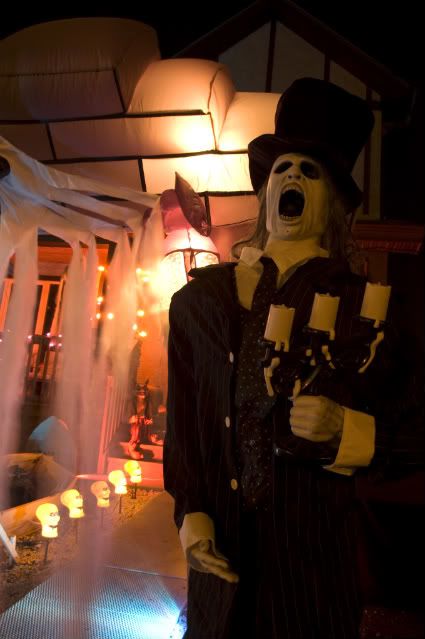
Fandango asked for something to do with a candleabra (here) and the very notion of it seems to conjor childhood nightmares for me. There’s a bit of Boris Karloff about it, don’t you think? The Adams Family used to own a lot of candleabras I believe.

So maybe, in a certain light, the congealed wax gathered at the base might be confused with blood and dried tears ….

Candlearbra

*

Little notions flicker bright

Burning softly in the night

A candelabra by the bed

That’s shone through every book you’ve read

Lighting paths within your head

Igniting fears, a glowing dread

Collecting blood already bled

Drying tears already shed


With dawn amnesia comes again

A brief respite to quell the pain

Forgotten horrors in the night

Hidden from the candlelight

Not out of mind, just out of sight

A raven that has taken flight

Still lingering, that fading dream

The burning wax still makes you scream

*

The Man Beneath the Glass

I made mention, a while ago, of the news that I had survived the first round of the NYC Midnight Short Story Competition. My second round entry showed vague promise Here but that was where it ended. The story came in 7th in the heat and needed to come in the first 5. Not dramatic enough, apparently. Bugger. Back to the drawing board.

So I entered the Flash Fiction competition and was asked to create a ghost story set in a dentist’s office and featuring a diorama.

It was all a bit of a rush. The first story I wrote I thought to be not too bad, but just before submitting it I realised that the maximum word count was 1000, and I had worked on 2000.

So the whole thing had to be halved (absolutely butchered, in other words) I made another technical error in submitting it and will likely be DQ’d. So this page will probably be as far as it gets.

***

The Man Beneath the Glass

A woman with a toothache debates art and history with a Nazi War Criminal.


She awoke in agony. The cheap gold implants from Thailand had not been such a great idea. The pain a retribution for the sin of pride. She took six codeines and followed them up with a line of coke before heading off to her hastily arranged appointment.

She found herself in the dentist’s waiting room beside an elderly gentleman cradling an ornate box upon his lap. He was gazing with wonderment around the space they shared. “Amazing!” he proclaimed.

She welcomed the opportunity to chat as a way of diverting her mind from the pain. “What is it?” she asked

He responded with a strong German accent, “This place,” he said, “the modernity of it all. Nothing like it in my day!”

“No.” She pointed to the box, “I mean what is that?”

“Oh,” he replied, “a diorama. A life’s work, in a way. A gift for my grandson. He’s the dentist.”

“So, you were a dentist too? A dior-what?”

“I was. And this is a sort of three-dimensional painting, to be interpreted from many perspectives.”

The drugs were having their effect and she imagined that any interpretation of her own may be thus inhibited. Or uninhibited. On closer examination she discovered the box to be an intricate model of a building, lightly brushed with snow and enclosed in a glass dome. The building itself was brown and drab, but beneath the snow she detected a faint glow. “You made this?” she asked.

“Yes I did,” he confessed proudly, “recently. Though it is a relic from the past.”

“A place where you lived?”

“Where I worked, in Germany, in a different world.” He held his hand out by way of formal introduction. “Martin,” he said.

She took his hand but recoiled at the coldness of his skin. “Hannah.”

“Hannah?” he repeated, “A Hebrew name. You are Jewish?”

“Not particularly.”

He grinned. “Shaking hands with a German! How things change! Or are we off to a bad start?”

“Not so far.”

A slightly uncomfortable silence ensued before he spoke again. “A German and a Jew walk into a dentist’s office. A joke?”

“Not a funny one.”

“Perhaps not. We Germans are not known for our humour.”

“And we Jews form a line of stand-up comics.”

“It’s good that you can laugh about it.”

“About what?”

“Never mind.” He was serious for a moment, and Hannah sensed in him something she didn’t like. She dismissed it as a reaction to the pain, or to the drugs, or to both.

“So, you made a model of a dentist’s surgery where you worked long ago as a dentist to present to your grandson, who is also a dentist,  and you put it in a glass box to protect it from what?”

“Are you mocking me?”

“Interpreting. From my perspective.”

“Time.”

“What?”

“I’m protecting it from time.” Even spoken gently, there was resentment in the words, and Hannah wondered if this grandson and the modern dentistry might represent that cold enemy – the relentless glacier of time. But the old man seemed to sense her thoughts and he spoke without being asked, “my grandson is a traditionalist. He understands the old ways.”

“Tradition can be dangerous.”

“Don’t lecture me on tradition, my young Jewess.”

“Please don’t use that word.”

“It is just a word.”

It was clear now. He was baiting her. “Don’t try to frighten me.” She despised him.

“The dentist frightens many, but in an age of modern anaesthetics, there remains little to fear. It wasn’t always that way.”

“In traditional dentistry, do you mean?”

They exchanged glares until the German changed tack. “Look into the diorama and tell me what you see.”

“I see a drab deserted building in the snow. I see desolation.”

“Yes,” responded the German, “quite beautiful. What else do you see?”

“I see something shining beneath the snow,” Hanna admitted, “maybe the faintest glimmer of hope.”

The old German placed his hands around the diorama and hugged it. “Then I approve of your interpretation. For that glimmer, that glitter, is gold. The last such surviving remnant of my work.”

The drugs were wearing off and she sensed that she was losing a battle. “Let’s stop,” she suggested.

But he would not be stopped. “The relationship between gold and dentistry is long, a tradition dating back to the Etruscans, and one practised by your ancestors. I can see, when you bare your teeth, as you so frequently do, that you honour that tradition.”

She clamped her jaws shut and felt the lightning rod of pain run through her body. “Please stop,” she begged.

He continued. “And you have heard perhaps, the rumours of dentists of the Third Reich, extracting golden teeth from the cadavers of deceased female prisoners of your own kind? Some of them not yet quite deceased, perhaps. Gruesome work. But rewarding. Repatriating those fading glimmers of hope to the rightful owners.”

She was sobbing now. The pain was overwhelming. “Who are you, Martin?”

“Like my art, like my work, I am open to interpretation. Who do you think I am?”

“I think you may be the devil.”

The German stood slowly and placed the diorama on his vacated seat. “Such has been said before. And now I have overstayed my welcome. Could you deliver this little gift on my behalf?”

And then he was gone.

*

The lights seemed suddenly brighter.

“Dr Hellinger will see you now.”

Hannah saw the approach of a man in white gown and surgical mask, a recognisable smile beneath the mask. She was holding the diorama, and she handed it to him. She saw the inscription on its base: Ravensbrück 1944.

“A gift from your grandfather,” she heard herself say.

Dr Martin Hellinger merely glanced at the gift. “Quite beautiful,” he murmured, the accent German, “and though the man you speak of passed away in 1988 he endures as my constant inspiration. Now come into my surgery and open your mouth wide. We will find what it is that troubles you.”


How could I refuse?

I thought it time to write something. Anything. And to write it quickly. My concentration span is so short these days that everything needs to be done quickly. I need to fit things in between daydreams.

I was reading about Linda’s SOC Here, which demands minimal time and thought and this week required that replies begin with a question. Mine was, ‘why do we need more questions?’, or something like that. I don’t think I even bothered to send it to Linda. It seemed rhetorical.

At the same time I read a comment about my latest contribution to Chel’s Terrible Poetry Contest Here, where I feel always on the very precipice of greatness. Somebody had the temerity to suggest that my poetry wasn’t sufficiently terrible, but I took that to be an expression of artistic envy, directed at one to whom ‘terrible’ is something that comes with such natural ease.

Anyway, to sort of settle things properly I sat down (very briefly)§ and wrote the following. It’s fairly terrible and although it doesn’t start with a question (a terrible disregard for the rules) it contains plenty of them. And provides no answers.

It ponders on matters that you have all heard from me before. The nature of true terribleness relies heavily on boring repetition.

*


Sunday

As the sun falls

A night yet to pass

Until Monday calls

The bells are ringing

Can you hear them too?

Are they calling me?

Were they calling you?

 Watching

As it all goes past

Remember a forever

That could never last

There was a light in your eyes

Is it shining now?

And music on your lips

I still hear somehow

 Darkness

But for passing stars

Are you out there still?

Is there life on Mars?

There’s a place up ahead

Where you used to be

I remember the address

I still hold the key

Smiling

She’s wearing your hair

A phantom in the mist

Breathing your air

There’s a ghost in the house

Wearing your shoes

And with a smile like that

How could I refuse?

 Monday

And the light returns

It’s cold in the house

Where the fire still burns

The music plays

It let it play for you

If the song ever ends

What am I to do?

*